Showing posts with label ciat. Show all posts

Thursday, September 23, 2010

CIAT present at the XI International Rice Conference for Latin America and the Caribbean

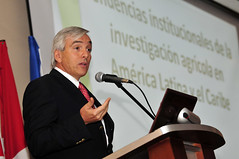
Rice conference 8Yesterday, 22 September, was the inauguration of the XI International Rice Conference for Latin America and the Caribbean, which has gathered the region’s scientists, producers, and entrepreneurs to discuss the current panorama of the rice sector and propose strategies that will allow it to better address the challenges posed by climate change, food security, and international markets.

Dr. Rubén Echeverría, the Director General of the International Center for Tropical Agriculture (CIAT), participated with the conference “Institutional Trends of Agricultural Research in Latin America and the Caribbean (LAC)”, giving an overview of the new impetus and positioning of agriculture on the current global agenda of research and development. He also pointed out the main challenges for agricultural research, which include poverty, climate change, and sustainable natural resource management.


The conference offered an overview of the different types of research and agricultural research organizations in LAC as well as recent institutional reforms in the region’s research and extension systems, including the capacity to generate and/or tap technological overflows.

Dr. Echeverría ended his presentation by addressing the impact of research on the rice sector and projecting the world demand for 2050. He is certain that the key challenge for the future of international research on this crop is to focus on those strategic areas where complementarity exists between national endeavors of the public and private sectors and the International Research Centers. An example of this type of networking initiative is the new global partnership formed by the International Rice Research Institute (IRRI), the Africa Rice Center (AfricaRice), the Latin American Fund for Irrigated Rice (FLAR), and CIAT.

Conference co-organizers are FLAR, Colombia’s National Rice Growers Federation (Fedearroz), IRRI, and CIAT.

Tuesday, September 22, 2009

Vice Minister supports CoCoon initiative at CIAT

Colombia’s Vice Minister of Environment, Housing and Territorial Development, Claudia Mora, was at CIAT today, to speak at the Conflict and Cooperation over Natural Resources (CoCoon) Matchmaking meeting.

cocoon6

The two-day conference at CIAT’s headquarters in Palmira has brought together experts to help strengthen regional ties in Central and South America. The resulting regional consortium, along with those formed in Africa and Asia/East Europe, will submit proposals to the WOTRO Science for Global Development on a natural resources projects that they hope to improve or manage. The projects will strive meet the United Nations’ Millennium Development Goals.

After her opening speech, Mora said she was grateful for the invitation. “The project comes at a time when there is ongoing work on conflict resolution in Colombia due to inequitable distribution of land and other natural resources. This could also boost the reception of national water policies that have just been put in place here,” she said.

cocoon4

CIAT’s Director General Ruben Echeverría was delighted to host the meeting: “The diversity of participants, who range from the indigenous people, to grassroots groups, to technical and social scientists, is a good way of starting to improve integration. We are happy to host CoCoon and look forward to a fruitful gathering.”

At the close of day one, CIAT’s Andy Jarvis presented to a group of delegates on the benefits of payments for ecosystems services. You can see his presentation here.

Jarvis_presentation_low

The meeting continues tomorrow with presentations and discussions on scientific research and action, capacity development, and alliances and partnerships for conflict management. For more about the CoCoon program, click here

Monday, May 25, 2009

Traditional linear research is no longer valid

Speaking about her poster at last week's CIAT knowledge sharing week, Myriam Sánchez, Director of Corporación Biotec in Colombia explains how her organization works through innovation systems. She argues that "traditional linear research is no longer valid, we need to go into more complex systems." It is also important to recognize that "the users have a lot of knowledge to share."

Sunday, May 24, 2009

Improving research uptake - Along the value chain

One of CIAT's core values, as elaborated by Louise Sperling, is to 'Reach End Users'.

Speaking at CIAT's 2009 knowledge sharing week, CIAT's Jean Claude Rubyogo explains how multiple actors in research in Africa work together in a 'value chain approach' to achieve improved uptake of bean varieties:


He also explains how CIAT works with the private sector in Africa to extend the uptake of bean seed:


See the posters:

Thursday, May 21, 2009

How suitable is your crop? Climate change and agriculture in 2020

climate change9 On Thursday morning, Andy Jarvis led the KSW 2009 special session on climate change and CIAT research.

He started by introducing the various global climate models and emission scenarios. They generally show a world that is warmer everywhere, in some places much warmer. It will also be wetter in most places, though some areas will be a bit drier.

Taking account of the different levels of uncertainty in each model and scenario, CIAT can use this data to project conditions in different research locations in 2020 and 2050.

Overall, he stated, global suitability for the top 50 crops increases. The question is which ones, and where.

climate change2 He described models used by CIAT and partners to 'map' the broad suitability of different crops in different regions, now and in 2020 and 2050.

These maps show many changes. Suitable conditions for some crops will increase; others will decrease. Some regions that currently grow, for example, maize or coffee, will no longer have conditions suited to these crops. Areas currently unsuitable, to cassava for instance, will become suitable. Production is likely to move to other, more suitable areas. Farmers will need to find substitute crops.

Some regions will be hard hit. In Southern Africa, conditions are likely to change so that maize will become unsuitable. Major agricultural - and even cultural - changes will be needed. The entire value chain of a product, he argued - from producer to consumer - will be affected, and will need to be transformed.

These models can also help in priority setting. The results of research, such as increasing a crop's suitability through improved heat or drought tolerance, can be included in the models to can help indicate the likely impacts of different CIAT research investments in different locations.

His conclusions for CIAT:

  • There is no single panacea in breeding strategies for most CIAT crops;
  • Regions face challenges at both ends of the spectrum – heat, drought, too wet;
  • Increased work is needed on the socio-economic implications;
  • Research needs to design now for 2020 climate conditions;
  • We face a serious scientific gap in understanding crop substitution, current models assume that a maize farmer today will be a maize farmer tomorrow. In reality, many will need to select a different crop to what they have now.
See also the KSW 2009 poster on 'The shifting geographies of crop suitability and the implications for food and nutritional security' gives more details / See a report on his March 2009 presentation in Copenhagen on this topic.

Wednesday, May 20, 2009

Science for Impact - Extending the Accessibility of CIAT Research

KSW - Opening Session 1 Ruben Echeverría shares some perspectives on an agenda for CIAT ...

On the first day of this KSW, some 50 staff members joined a session organized with the support of the ICT-KM program to discuss the availability and accessibility of CIAT’s research outputs [see presentations].

At the end of the session, I asked the session organizers to come up with some concrete actions that CIAT could consider implementing. I’m pleased to share some of the promising ideas that emerged:

In the very short term, I would like to see us consolidate available knowledge information and data in CIAT, investing in these, and perhaps other, actions to maximize the accessibility of our work.

What might this include?
  • I would like to see us use ‘open’ as the default setting to share our research outputs. With support from the CGIAR CAS-IP and borrowing from IRRI, we can adopt a suitable ‘creative commons’ license for all of our Center-produced outputs.
  • Where we publish elsewhere, we need to ensure that copyright agreements with publishers allow us to retain CIAT rights to re-use the publications and for us to deposit them in our open repositories. 
  • We also need to look at our agreements with partners, collaborators, funders and others to ensure any outputs they generate are also published and deposited under similar licenses.
  • We urgently need an ‘all of CIAT’ approach and strategy to guide information, knowledge, data and communication policies and investments. This needs to tackle some of the important issues raised on Monday – such as the concern for quality, prioritization, and management of expectations and real demands.
  • We must deposit all CIAT research outputs in publicly-accessible repositories where they are permanently available and can easily be found and re-used. Some of our internal repositories need to be reviewed and migrated outside our intranet to be publicly accessible. If we don’t know all that we know, we can hardly share it!
  • Many of us need to brush up our skills in this area. I would like to see concrete activities that equip staff to become ‘smarter’ communicators and sharers throughout the research cycle. We need to better understand the possibilities open to us, even if we continue to rely on expert colleagues for some help.
  • Simone’s presentation and indeed the efforts of our CCC and IT teams this week to open up and share KSW discussions, suggest that we can gain a lot from social media like blogs and video that can increase our ‘social footprint’ – beyond words and text!
  • Beyond these trendy social tools, we should also continue to support other innovative applications, such as geo-spatial applications where we have a lot already to build on. There may be other applications like mobile devices or participatory video that are worth exploring.

    Jarvis

  • We need to look at our web presence – our main website should offer gateways to CIAT knowledge, with appropriate mechanisms for decentralized content management and editing. We also need to examine the Forages platform to see if indeed it is a model to develop other specialized knowledge sharing platforms that reinforce and give greater visibility to what we do.
  • A recurring theme is the incentives – why should staff engage in all of this? I will propose that we look at our personnel systems to see how we can encourage and recognize activities that result in open and accessible, as well as high quality, research.
  • Finally, we will need sufficient bandwidth in all of our offices to ensure we can indeed support some of these new kinds of ‘e-science.’ Appropriate use of this bandwidth will be encouraged.
Alongside these internal interventions, we can extend this approach with our partners across this region, and perhaps beyond, to help create a Latin American ‘Agricultural Commons’ that transforms the way knowledge is generated and applied in the region. This resonates with our Wednesday discussions on ‘reaching end users’ that calls on us to work with partners to get our research out, to make sure we do science for impact!

How do we take this forward? We need a Center-wide forum that brings the different perspectives and expertise together. Perhaps we can set up a knowledge ‘task force’ to give us impetus and guidance in the coming months?

We will discuss some of these plans again in this knowledge sharing week; I welcome feedback and suggestions from CIAT colleagues and partners … and look forward to continue this discussion.

Ruben

Reaching end-users : Let’s rethink who is the "pea" and who is the "elephant"

SPD1 Louise Sperling kicked off Day 3 of CIAT’s KS week by stimulating our thinking around the issue of 'Reaching End Users' (REU).

“While REU was rejected as a deliberate thrust in CIAT’s strategy, and is not visible in the MTPs, the ideas around REU are very high on the agenda of the new CGIAR where planned funding mechanisms and concepts should change dramatically to become far more interactive”, she said.

Louise gave two examples that highlight the benefits of a REU approach for CIAT’s research:

SPD2 Beans: The work and research on seed systems was very impact orientated, involving more and different kinds of partners, with a focus on setting up new platforms and non-linear models. The quick decentralization and outreach channels helped this work benefit some 8 million people in just 4 years.

Agroenterprises: Mark Lundy’s work has shown that markets are needed to make our research useful and “get our methods out”. His work focused on scaling up partners in Central America so that they can link farmers to markets. This successful partnership work is based on the following organizing principles:

- Clear shared objectives
- Shared responsibilities, costs and benefits
- Outputs as inputs for innovation
- Learning cycle: empirical evidence for theory dev
- Policy implications
- Improved practices

SPD11 The 4-year program involved 25 organizations and 36,000 farm families. It increased income related to natural resource and had concrete gender equity impacts. The processes proved to lead to sustainability as partners are able to continue on their own after the end of the project.

Both examples showcase how much REU includes efforts to adopt practices based on research outputs, for organizational changes, and for better collaboration with partners.

“This approach could be used by our crops, and the soils programs”, suggests Louise. She also wonders if issues like benefits for poor women, policy changes and new organizational models are really only related to delivery. REU is more than that: It is an invitation to rethink the kinds of impact that CIAT wants to report.

SPD8 “Let’s rethink who is the pea who is the elephant. I would say that CIAT is the pea and wonder how can we leverage the huge potential for the elephant.” This metaphor reminds us that very big and influential potential partners are out there and that we have to get them on board if we want to promote our research and its uptake.

How to implement REU? Louise suggests to:

- Define our mandate
- Synthesis high profile lessons
- Build a strategy
- Map intra center opportunities for impact on the ground
- Raise funds strategically across programs for REU

The discussion focused mainly on partnerships. Here are some reactions:

- We have to go to certain key partners with global outreach, invite them to join from the beginning. A strategic approach would be much more effective.

SPD3

- We need to have multiple and mixed partners with high and lower levels of engagement. We focus on INGOs but there are farmer associations and private companies who can help in leveraging. We need to begin to build more diversity and resilience within the system. Focusing only on one partner (for budget reasons) is risky and often doesn’t work.

SPD5

- Sometimes you don’t choose your partners and you have to deal with difficult partners.

- We have too small budgets for dissemination and cultivating partnerships: The problem with partners is not money, the NGO partners having way more money. The problem is that we don’t have what they want. We need active participants in a co-learning process instead of passive delivery. We should support others to reach end users instead of trying to reach them ourselves.

Ruben

- The CGIAR is really moving to science for impact. It is a fantastic opportunity for CIAT.

- REU is a cross-cutting core value. It has to be integrated into our MTP, and projects, but not necessarily as a program. More strategy around REU would be useful to institutionalize REU.

SPD4

- End users or users: we are not talking about poor farmers only. We need to better characterize who our users are.

Stay tuned...

By Simone Staiger

LAC Biotechnology platform : A regional consortium to integrate, catalyze, and empower!

The morning discussion about partnerships in the Reaching End User session linked nicely into Joe Tohme’s presentation about a Latin American and Caribbean Biotechnology platform. Joe concedes the idea is not new, having been discussed for several years but it has now been pushed forward in the new strategic plan, based on broad consultation with regional partners like Foragro, Corpoica, Embrapa and Catie.

Tohme4

Joe started by highlighting the fact that we are talking about a LAC platform, not a CIAT platform for biotechnology research, services, and capacity building. The LAC region is rich in diversity, and provides important sources of income to the poor, but the region faces problems related to its poor collections, its weak knowledge base, little technical expertise, production constraints, and a lack of infrastructure.

Tohme3


The region's biotechnology work has focused mainly on highly-industrialized crops, like coffee or sugar cane so far. Joe pointed out that potential investors need more information about what is available in terms of collections, and what the nutritional and economic value is. The platform will respond to specific scientific needs (breeding, phenotypic characterization, access to genomic facilities, bioinformatics...), train the next generation of LAC researchers (a key area) and enhance LAC competitiveness. Joe believes CIAT is well positioned to host this platform and paid tribute to the excellent Colombian staff, and the organization's proven capacity to develop and exploit genomics and cellular technologies.

Tohme2

The platform will have two structural components, which will take several years to develop: a policy / intellectual property platform, and a technical platform.
The key elements for delivery are partnerships and the “dream team” in about 10 years should include strong breeding capacity with knowledge of genomic tools, linked to efficient phenotypic characterization, and access to genomic tools at national regional.

Next steps include an upgrade of CIAT’s infrastructure and fundraising for CIAT AND our partners to establish different components.

By Simone Steiger

Africa’s Development Initiatives

Participants in Knowledge Sharing Week 2009 have been taking a closer look at some of CIAT and it partners' development initiatives in Africa. The African Soil Information Service (AfSIS) is exciting example. An organization working with TSBF in 42 African countries, its core business is to address some of the soil constraints that African farmers face, for example erosion. The program’s studies will however be carried out in: Mali, Nigeria, Kenya, Tanzania and Malawi. Click here to view the presentation by Peter Okoth.

The African Institute for Soil Biology and Fertility (AfNET), like AfSIS is working with TSBF, but working as a network of scientists to strengthen stakeholder capacity to generate, share & apply soil fertility management knowledge & skills to contribute to the welfare of farming communities. For the presentation by Saidou Koala, click here.

These two centers seek to work with other CIAT centers to share knowledge and achieve best results especially in overlapping areas like cassava research. The results from any mergers or initiatives made from these will be shared next year.

Send us your comments and keep up with the knowledge sharing week here!

Tuesday, May 19, 2009

Introducing CIAT in Africa

During the Tuesday morning session of the Knowledge Sharing Week, Nteranya Sanginga welcomed the Director-General Ruben Echeverria to CIAT, and also invited him to visit the organization’s Africa office. Sanginga then provided a presentation on the highlights of the Tropical Soil Biology Fertility (TSBF) program. He introduced AfSIS and AfNET, important inititatives that aim to partner with many organizations active in knowledge sharing and research.

Sanginga1

Bernard Vanlauwe from the Integrated Soil Fertility Management (ISFM) Program then gave a presentation highlighting its 3 main aims in Africa. These are: having legume cereal based systems, having cassava & rice-based systems and introducing conservation agriculture systems. Also mentioned here were the resources that ISFM currently needs in order to achieve its goals? These include: funding, staff and infrastructure. For the full presentation, click here.

Audience1

Kristina Róíng de Nowena from the SLU (Sveriges Lantbruks Universitet {Swedish University of Agricultural Sciences}) touched on the collaborations that the university and SIDA (Swedish International Development Agency) has with various research organizations worldwide. SLU wants to be a key partner to TSBF, CIAT and the CGIAR in agricultural research for development, to help achieve food and nutritional security for all. For more on this, click here.

soil2

For more on the upcoming merges and centers, keep checking this blog.

Monday, May 18, 2009

Exploring Eco-Efficient Agriculture

Joe Tohme opened the Eco-Efficient Agriculture session, offering several definitions of the term, ranging from one paragraph to two pages – you can find out more here:

The highlights of the session as a whole included presentations and discussions about the benefits and impacts of eco-efficiency.

Speakers also covered the abiotic constraints, pest and disease threats, the importance of the conservation of natural resources and what eco-efficiency means in different parts of the world.

For more details, you can see the presentations.

As the session came to a close, there was vibrant discussion about the concept of eco-efficient agriculture and how it can be achieved. Why don’t you join in the debate by posting your comments? We look forward to hearing from you.

Stay tuned for the next KSW update.
CCC Team

Friday, May 15, 2009

Poster exhibition at CIAT Knowledge Sharing Week

Check out the nearly 100 posters prepared for the discussions this week.