
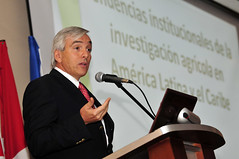
 Yesterday, 22 September, was the inauguration of the XI International Rice Conference for Latin America and the Caribbean, which has gathered the region’s scientists, producers, and entrepreneurs to discuss the current panorama of the rice sector and propose strategies that will allow it to better address the challenges posed by climate change, food security, and international markets.
Dr. Rubén Echeverría, the Director General of the International Center for Tropical Agriculture (CIAT), participated with the conference “Institutional Trends of Agricultural Research in Latin America and the Caribbean (LAC)”, giving an overview of the new impetus and positioning of agriculture on the current global agenda of research and development. He also pointed out the main challenges for agricultural research, which include poverty, climate change, and sustainable natural resource management.
The conference offered an overview of the different types of research and agricultural research organizations in LAC as well as recent institutional reforms in the region’s research and extension systems, including the capacity to generate and/or tap technological overflows.
Dr. Echeverría ended his presentation by addressing the impact of research on the rice sector and projecting the world demand for 2050. He is certain that the key challenge for the future of international research on this crop is to focus on those strategic areas where complementarity exists between national endeavors of the public and private sectors and the International Research Centers. An example of this type of networking initiative is the new global partnership formed by the International Rice Research Institute (IRRI), the Africa Rice Center (AfricaRice), the Latin American Fund for Irrigated Rice (FLAR), and CIAT.
Conference co-organizers are FLAR, Colombia’s National Rice Growers Federation (Fedearroz), IRRI, and CIAT.


